
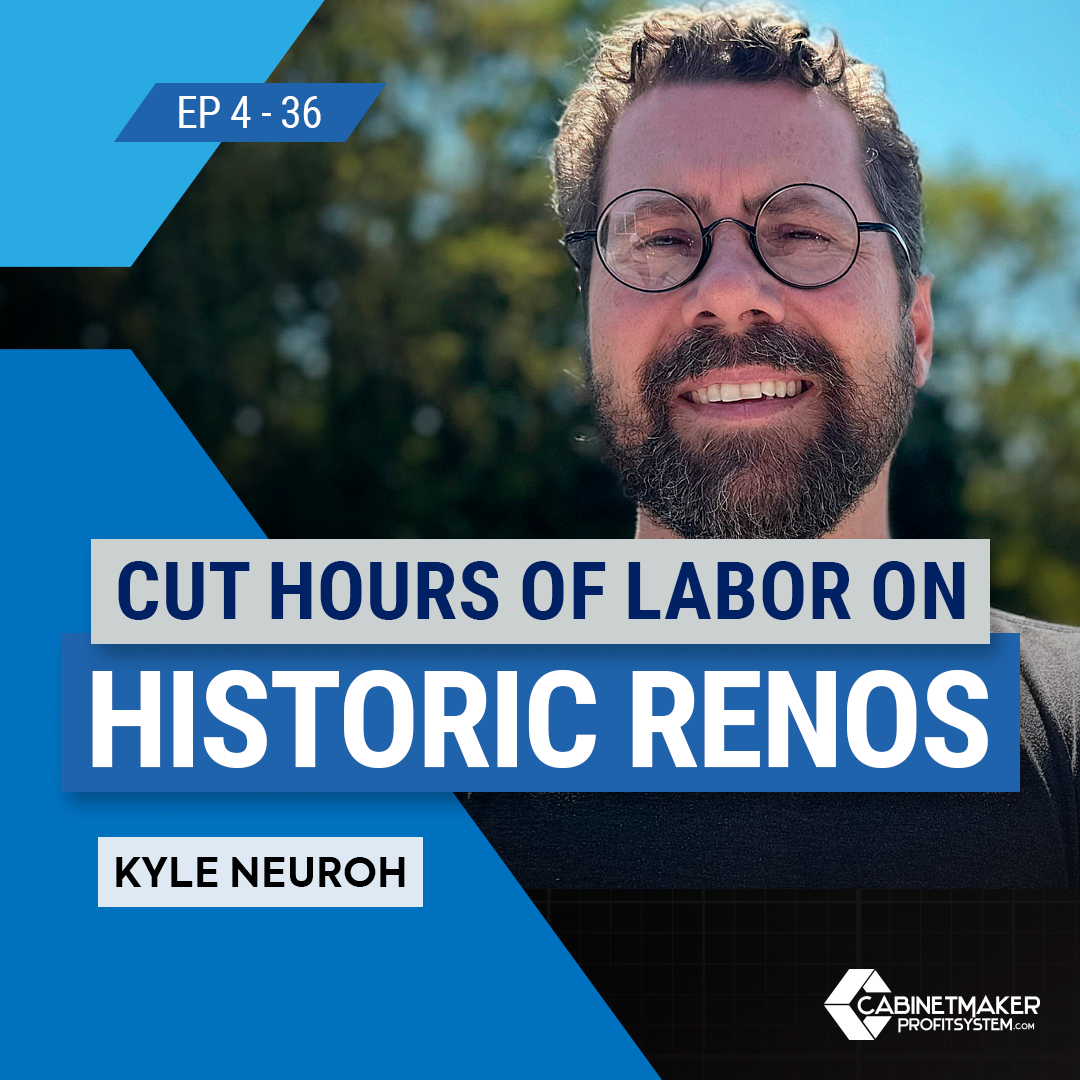
Episode
36
Thu, 17 Sep 2026 12:05:00 +0000
Labor is one of the biggest variables contractors have to manage.
You can estimate a job carefully, build in your expected hours, and still watch profitability disappear when a difficult restoration takes longer than expected.
Historic renovations can make that problem even more complicated.
Detailed stair parts, architectural millwork, cabinet doors, exterior doors, and other finished wood surfaces may need to be stripped without destroying the original profiles underneath. Traditional methods can involve sanding, scraping, chemical stripping, disassembly, transportation, refinishing, and reinstallation.
But what if there were another way?
On this episode of CMPS + PTB, Dominic Rubino talks with Kyle Neuroh about how laser cleaning technology is creating another option for contractors tackling labor-intensive restoration work.
When contractors encounter detailed architectural woodwork, simply sanding the old finish away isn't always practical.
Rounded surfaces, valleys, profiles, balusters, handrails, newel posts, and veneered surfaces can all create challenges.
Kyle explains that his company historically dealt with stair renovations by disassembling parts of the system and refinishing them elsewhere. Some components could even be more practical to replace than restore because of the time involved.
Historic work changes that equation.
When the original material has historical or architectural value, replacing it may not be desirable. Contractors need a method that preserves the original piece without turning restoration into an enormous labor expense.
That's where laser cleaning becomes interesting.
The technology Kyle discusses uses a pulse laser.
Rather than mechanically sanding away the underlying material, the laser can target the finish on the surface. Depending on the material and finish, that coating can flake, crumble, lift, or vaporize.
The goal is to remove the unwanted finish while minimizing damage to the material underneath.
That can be particularly valuable on detailed wood profiles where aggressive sanding could alter the shape of the original piece.
It also opens the possibility of performing certain restoration work in place.
Instead of automatically taking an architectural feature apart, moving it to the shop, refinishing it, transporting it back, and reinstalling it, contractors may have another option.
And every one of those eliminated steps potentially represents saved labor.
One of the most attention-grabbing examples from the conversation involves cabinet doors.
Kyle says they have timed the process at approximately two to two and a half minutes to clean a standard cabinet door down to bare wood.
According to Kyle, the complexity of the profile doesn't necessarily create the same obstacle it would with traditional sanding. Flutes and raised-panel profiles can still be reached by the laser.
After cleaning, the wood is left slightly textured and can be lightly sanded before being recoated.
Kyle is also careful to point out that the technology isn't a silver bullet. Different finishes respond differently, and operators need to understand how to adjust the equipment for the surface they're cleaning.
That's an important distinction.
The opportunity isn't “zero labor.”
It's using technology to remove unnecessary labor from parts of the process that have traditionally consumed a lot of it.
Historic renovation creates another opportunity.
Consider an original staircase in a century-old home.
The homeowner may care deeply about preserving the original newel posts, balusters, handrails, and architectural character.
Traditional restoration might require significant disassembly and manual refinishing. Replacement could be easier from a labor perspective, but it sacrifices the original material.
Laser cleaning can potentially give contractors another choice: remove the existing finish while keeping the original profile and performing more of the work in place.
That's not simply a labor-saving story.
It's a value proposition for the customer.
A contractor who can say, “We may be able to preserve this original feature instead of replacing it,” is offering something different from a competitor whose only practical solution is demolition and replacement.
This is where the technology becomes especially relevant to construction business owners.
Saving an hour isn't just about finishing earlier.
Labor is a cost.
If one contractor has to dismantle an architectural feature, transport it, refinish it, return it to the jobsite, and reinstall it while another contractor can perform more of that restoration in place, those two businesses have very different cost structures.
The contractor with the more efficient process could potentially bid more competitively.
Or they could price similarly to competitors while retaining more margin.
They may also be able to offer restoration options that previously weren't financially practical.
That's the larger lesson from the conversation: tools don't only change how the work gets done. Sometimes they change how a job can be sold, estimated, and delivered.
Technology doesn't eliminate the need for skilled operators.
Kyle estimates that someone could become reasonably comfortable after roughly a day of training, with their skill continuing to improve through experience.
Operators need to understand focal distance, movement, settings, materials, and how different finishes respond.
In other words, this isn't simply a machine you hand to an employee without training.
The tool may reduce physical labor, but knowledge still matters.
A laser also introduces safety considerations.
Kyle discusses reflected laser light, particularly when working with reflective materials such as metal. Protective glasses, face protection, barriers, ventilation, and proper training can all become part of the process depending on the application.
That makes implementation important.
The business opportunity comes from combining the technology with trained employees and proper procedures — not from ignoring the risks because the tool makes the work faster.
The conversation also highlights several other possible applications.
Laser cleaning can be used for cabinet and furniture refinishing, surface preparation, metal cleaning, graffiti removal from brick or stone, manufacturing processes, and cleaning industrial molds.
The common theme is simple:
Remove something unwanted from a surface while preserving what is underneath.
For contractors and manufacturers, that can create opportunities to reduce steps that traditionally require chemicals, sanding, scraping, or other labor-intensive processes.
The real takeaway isn't that every contractor needs a laser tomorrow.
It's that every contractor should continually ask:
“Why are we still doing this part of the job this way?”
The construction industry has plenty of processes that continue simply because that's how they've always been done.
But when labor represents a significant portion of project costs, finding a faster way to complete repetitive or difficult work can have a direct impact on profitability.
Technology that saves minutes on one task may not sound transformational.
Multiply those minutes across dozens of pieces, multiple employees, multiple jobs, and an entire year, and the economics start looking very different.
For contractors doing historic renovations, cabinetry, architectural millwork, flooring, or restoration work, laser cleaning is one technology worth watching.
Because sometimes the best way to protect your margin isn't charging more for the old process.
It's finding a better process.
The blog intentionally keeps claims measured because Kyle says the results depend on the type of finish and describes the technology as “not a silver bullet.” That keeps the marketing aligned with what the episode actually delivers.
More about Kyle Neuroh:
LinkedIn: https://www.linkedin.com/in/kyle-neuroh-805b05108
Website: https://www.neurohhardwood.com/
Instagram: https://www.instagram.com/neurohhardwood
Facebook: https://www.facebook.com/Neurohhardwood/
Connect with Us:

.svg.webp)


